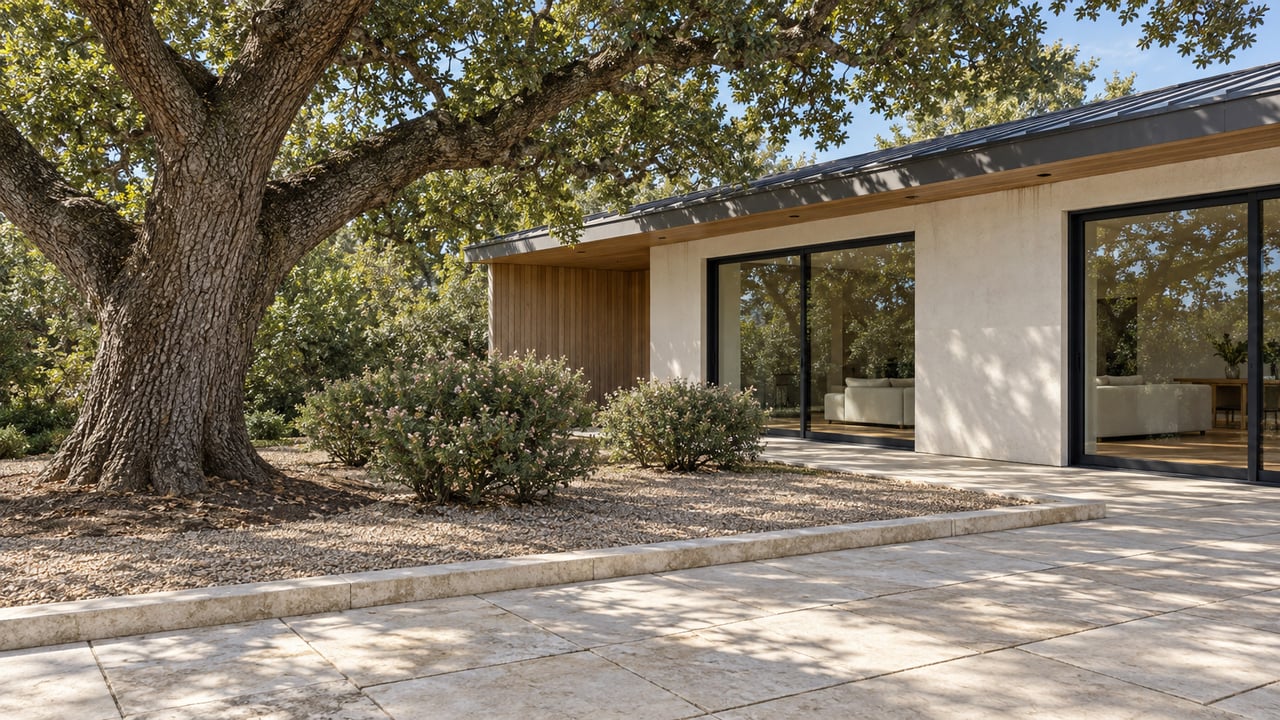
Monte Sereno's online tree removal application asks for each tree's size measured in circumference, four feet above the ground. Most buyers picture a tree's size as the width of the trunk, so the city's measurement catches people off guard. Under Chapter 10.15 of the Monte Sereno Municipal Code, an oak or redwood becomes a protected "significant tree" once its circumference passes 20 inches at 48 inches above natural grade. Any other tree qualifies past 25 inches. Twenty inches around works out to a trunk about 6.4 inches across, which is a young coast live oak.
That low threshold means a lot of trees are protected. The more interesting part of the code is how the permits are sorted. Taking out a significant tree for a pool, a patio, or a better view generally means a public hearing before the Site and Architecture Commission. Taking out the same tree for a qualifying ADU, two-unit, or lot-split project goes to a staff member who, under the code's wording, "shall approve" the permit as long as the trees are replaced. If you're comparing two Monte Sereno lots, the trees shape what you can realistically do with each yard, and the plans that are easiest to permit may not be the ones you had in mind.
A Small Number on a Different Scale
The circumference measure makes Monte Sereno's thresholds look larger than they are, especially next to the town next door. Los Gatos measures diameter. According to the Town of Los Gatos tree permit FAQ, protected trees on developed residential lots are generally 12 inches in diameter or larger. Hillside residential lots and certain species use an 8-inch threshold, and vacant lots, nonresidential lots, and removals tied to development review use 4 inches.
| Situation | Code threshold | Approximate trunk diameter |
|---|---|---|
| Monte Sereno, oak or redwood | Over 20 inches circumference | About 6.4 inches |
| Monte Sereno, any other tree | Over 25 inches circumference | About 8 inches |
| Los Gatos, developed residential lot, general rule | 12 inches diameter | 12 inches |
| Monte Sereno, large oak with added protection | 115 inches circumference or more | About 36.6 inches |
On a typical developed lot, a coast live oak that Los Gatos wouldn't regulate can be a significant tree in Monte Sereno. That matters as soon as you start sketching a yard.
Two Doors Into the Same Permit
Section 10.15.040 sets up two ways to get a removal permit. The City Manager or City Planner handles dead trees, "unsuitable" trees, and any removal tied to a project first permitted under three sections of the code. Those are Section 10.05.080, which covers residential development projects of up to two units on a lot; Section 10.06.140, which covers accessory dwelling units; and Chapter 13.06, which covers lot splits. Every other significant-tree removal needs a permit from the Site and Architecture Commission or the City Council.
The two paths work very differently. On the Commission path, the city mails notice to every property owner within 300 feet and holds a hearing where anyone interested can speak. The Commission then decides:
- Whether removal is needed to allow "reasonable economic enjoyment of the property," or because of disease, danger of falling, or threat to people.
- Whether, given the topography, removal would significantly affect erosion, soil retention, or surface water flow.
- How many trees exist in the neighborhood on improved property, and how removal would affect "the established standard of the area and the property values."
- How many trees the parcel can support under good forestry practices.
The third test asks the Commission to weigh your neighbors' tree cover and their property values when it rules on a tree in your yard. If it approves, it may require replacement trees that match the removed tree's size, height, location, and appearance.
On the housing path, the code says the City Manager or City Planner "shall approve" the permit, on the condition that each removed tree is generally replaced with two native or drought-tolerant trees, each at least 10 inches around as planted. Unsuitable trees follow a different replacement rule, covered below. The site development side follows the same pattern. Ordinance NS-247, adopted November 4, 2025, says residential development projects under Section 10.05.080 are reviewed "ministerially and without public hearing by the City Planner," while other site development permits go to the Commission.
The code's own wording shows how it treats these projects. Its large-oak rule refers to ADU projects "subject to mandatory approval" under Government Code Section 65852.2(e), and it measures two-unit and lot-split projects against the ability to build two units of at least 800 square feet each. For these categories, the code sets a fixed replacement formula instead of a discretionary hearing. A pool gets no such formula.
Where the Housing Path Draws a Line
The faster path has a limit. The City Manager or City Planner may not approve removal of an oak that measures at least 115 inches around at 48 inches above grade unless the applicant shows one of three things. The project is an ADU that state law requires the city to approve. Or denial would physically prevent building up to two units on the lot, or prevent either unit from reaching 800 square feet. Or, for a lot split, denial would prevent up to two units per new parcel, or prevent them from reaching that same 800 square feet.
On the housing path, then, staff can approve removing an oak of 115 inches or more only when keeping it would block the qualifying ADU, or would physically prevent two units of at least 800 square feet each. If a design can fit those units around the oak, the oak stays.
Replacement also depends on which tree comes down. When an "unsuitable" tree is removed for one of these housing projects, the replacement is one native or drought-tolerant tree in a 24-inch box instead of two smaller trees. The city's unsuitable list covers blue gum and red gum eucalyptus, black acacia, tree of heaven, tulip tree, all palms, privet, Monterey pine, and fruit trees. Removing a dead or unsuitable tree outside a housing project still needs a permit, but staff decide it in writing without a hearing. The city may ask for an arborist's report on a dead tree, or proof of species for an unsuitable one, at the applicant's expense.
What a Commission Hearing Looks Like
At its January 8, 2025 meeting, the Site and Architecture Commission took up a site development application on Karl Avenue that included removing four trees: a Valley oak, a Japanese maple, and two coast live oaks. Staff described the coast live oaks as being in poor condition. One of the coast live oaks was described as 53 inches in circumference, or 17 inches in diameter. The Commission approved the site development and tree removal permits unanimously. It added a condition calling for mutual agreement about the trees along the north property line.
The application was approved, but only after a public meeting, a staff assessment of the trees' condition, and a condition covering trees at a shared property line. That's the process a buyer should expect for an ordinary remodel or new house when significant trees are involved.
Removal Covers More Than a Chainsaw
Chapter 10.15 defines "remove" broadly. It includes topping, excessive pruning, excessive watering, and excessive excavation, grading, or soil changes within a tree's dripline, plus any action that will reasonably and foreseeably kill the tree or permanently damage it. A trench for a new drain line or a patio slab poured under an oak's canopy can count as removal even if the tree is still standing.
During construction near a significant tree, the property owner must put up and maintain a protective fence at least five feet from the trunk. If that isn't possible, the City Manager or a designee looks at the tree and sets the distance. For site development applications, the city requires an arborist report when a proposed structure reaches into a tree's dripline or canopy, or when three or more significant trees are slated for removal. Plans must show trees within 50 feet, and trees proposed for removal must be marked with red ribbons.
Removing a significant tree without a permit can bring a $1,000 citation and a retroactive permit at double the application fee. The city can also require replacement trees of "equivalent aesthetic quality." If replacement can't achieve that, the city can require a cash payment based on the tree's appraised value under the Council of Tree and Landscape Appraisers guide, plus planting costs. The code treats that payment as a debt the city can collect in court.
What This Changes When You Compare Two Lots
The site development permit is usually what triggers tree review. Under Ordinance NS-247, you need one for a new main house; an addition of 500 square feet or more in the R-1-8 zone, or 750 square feet or more in R-1-20 and R-1-44; a roof change that raises the height by more than 24 inches; a second-story addition of 250 square feet or more in R-1-8, or 500 square feet or more in the larger zones; and any second story added to a one-story house. The ordinance's opening recitals say the city wanted to amend both its site development and tree removal requirements, and the Site and Architecture Commission recommended adoption on a 4-1 vote.
Fees are modest next to the time involved. The city's fee schedule under Resolution 22-3863, which took effect November 7, 2022, lists $100 for a significant-tree removal sent to the Site and Architecture Commission. Site development fees run from $2,060 for smaller remodels and additions to $3,040 for a new house, a rebuild, or a remodel of at least 50 percent of existing floor area, and $3,370 for hillside development. The bigger costs are the arborist, the redesign, and the weeks spent waiting for a hearing.
In practice, a lot with mature oaks near the spot where you'd want a pool, an addition, or a second story comes with a public process. A lot whose large trees are on the unsuitable list, or sit outside any planned building area, comes with much less. Two homes with the same square footage on the Monte Sereno market can offer very different yard options once the trees are measured. This affects sellers too. Owners preparing an estate home to list may want any tree work permitted, and documented, before buyers start asking about it.
This is general information about Monte Sereno's published code, not legal, tax, or financial advice. Confirm your property's situation with the city's planning staff, a certified arborist, or your own attorney before you rely on it.
A Few Direct Questions
Do I need a permit to remove a fruit tree? If it's large enough to be a significant tree or it's dead, yes. On a lot used for a dwelling, fruit trees are on the unsuitable list, which sends the application to a written staff decision instead of a Commission hearing.
Can I remove a tree that's about to fall? The code exempts emergency removal of a hazardous significant tree when the City Manager or the Manager's designee has approved it.
Where do I apply? Through the city's ePermits tree removal application. The form asks for tree type, circumference measured four feet above the ground, location, and reason, and it lets you attach photos or an arborist report.
If you're weighing a Monte Sereno property and want to know what its trees allow before you write an offer, or you're getting a longtime home ready for sale and want the tree questions settled first, Knight Roberts Real Estate can help you work through the measurements, the permit path, and the timing. Work With Us.
